EUDR Compliance Checklist: 7 Steps Before December 2026
A practical step-by-step checklist for EU importers to achieve EUDR compliance. Covers supply chain mapping, geolocation, risk assessment, and DDS submission.
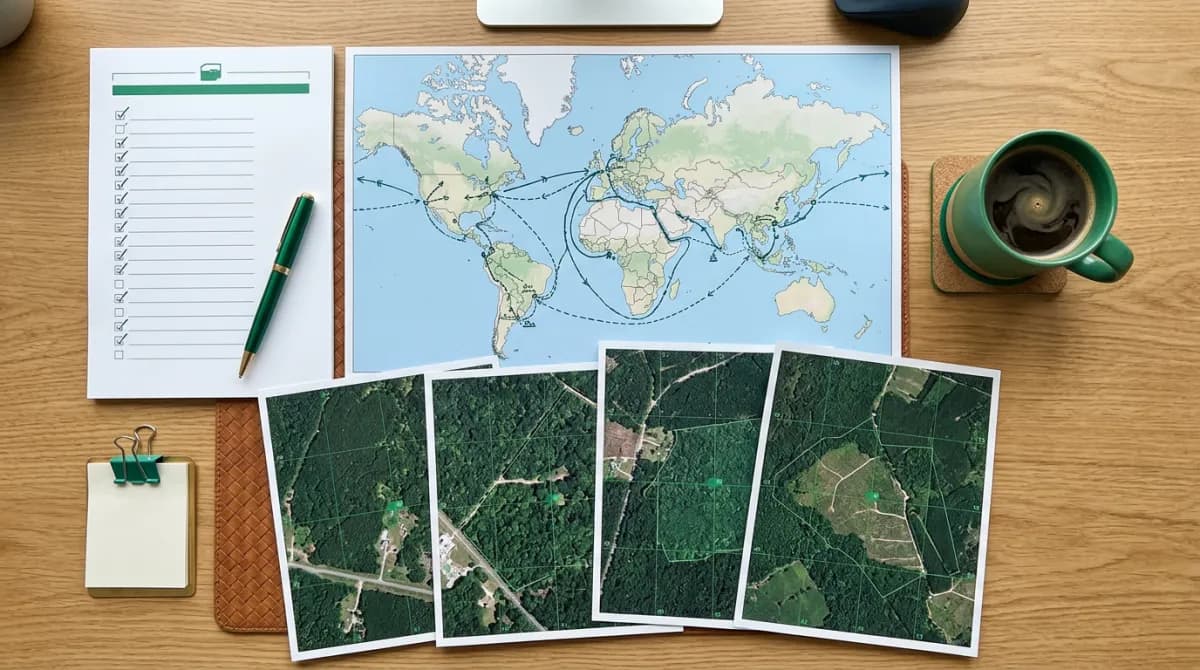
With the EUDR enforcement deadline set for December 30, 2026, importers need a clear action plan. This checklist breaks down compliance into seven concrete steps.
Step 1: Identify Your Regulated Products
Review your product portfolio against the EUDR's commodity list and HS codes. The regulation covers seven commodities — cattle, cocoa, coffee, oil palm, rubber, soya, and wood — plus their derived products. This means chocolate, leather goods, paper, furniture, and even printed books are in scope.
Action: Cross-reference your customs declarations with the EUDR HS code list. If any of your products contain regulated commodities, you need to comply.
Step 2: Map Your Supply Chain
For each regulated product, trace the supply chain back to the point of production. This means identifying:
The country of production
The specific region or municipality
Ideally, the individual farm or plantation
Action: Request supply chain data from your direct suppliers. For complex supply chains (e.g., soy in animal feed), you may need to trace through multiple intermediaries.
Step 3: Collect Geolocation Data
The EUDR requires GPS coordinates for every plot of land where your commodities were produced:
Plots under 4 hectares: Provide a single coordinate point [longitude, latitude]
Plots 4 hectares and above: Provide the full polygon boundary
Data must be in GeoJSON format using WGS84 (EPSG:4326) coordinates.
Action: Work with suppliers to collect GPS data. Use Silvatrace's free GeoJSON validator to check file compliance.
Step 4: Conduct Risk Assessment
Evaluate each sourcing area for deforestation risk. The assessment should consider:
Satellite imagery comparison (before and after December 31, 2020)
Country and regional deforestation rates
Proximity to protected areas or indigenous territories
Historical land use change patterns
Action: Use satellite-based tools like Silvatrace to run automated NDVI (Normalized Difference Vegetation Index) change detection analysis on each plot.
Step 5: Mitigate Identified Risks
If your risk assessment identifies non-negligible deforestation risk:
Request additional documentation from suppliers
Conduct on-the-ground verification
Consider alternative sourcing
Implement monitoring programs for ongoing risk management
Action: Document all mitigation actions taken. The EUDR requires you to demonstrate that risks were reduced to a "negligible" level.
Step 6: Prepare Due Diligence Statements
For each shipment of regulated goods, prepare a DDS that includes:
Operator identification (name, address, EORI number)
Product description with HS codes
Quantity and unit of measure
Country and geolocation of production
Risk assessment results
Mitigation measures taken (if applicable)
Action: Use a compliance platform to generate DDS documents that meet TRACES NT submission requirements.
Step 7: Submit and Retain Records
File your Due Diligence Statements in the EU TRACES NT system before placing goods on the market. Retain all documentation for a minimum of 5 years.
Action: Set up a record retention system. Organize files by shipment, commodity, and supplier for easy retrieval during audits.
Timeline Recommendation
| When | Action |
|---|---|
| Now – June 2026 | Steps 1-3: Identify products, map supply chain, collect geolocation |
| July – September 2026 | Steps 4-5: Run risk assessments, mitigate risks |
| October – November 2026 | Step 6: Prepare DDS templates and test TRACES NT submission |
| December 2026 | Step 7: Go live with full compliance |
Need Help?
Silvatrace automates the most technical aspects of EUDR compliance — geolocation validation, satellite-based risk assessment, compliance report generation, and DDS preparation. Start with 3 free assessments at silvatrace.com.